Takeda Castle Ruins|The “Castle in the Sky” Above the Clouds
Takeda Castle Ruins — “Castle in the Sky” Above the Clouds —
Author: Richard Perkins
Photos/Videos Taken: 2025/08/22
Address: 169 Kojoyama, Takeda,
Wadayama-cho, Asago, Hyogo 669-5252
Castles can be found throughout Japan. Some are reconstructed replicas, while others retain their original structures. At certain sites, the castles themselves no longer exist, leaving only the grounds behind. One notable example is Takeda Castle, where only the ruins remain. Known today as the Takeda Castle Ruins, it’s a captivating destination for both tourists and locals alike.
Takeda Castle was built during the Kakitsu period (1441–1444). Yamana Sōzen (a general and provincial military governor during the Muromachi Period—1336-1573—) ruled Tajima (the northern part of modern-day Hyogo Prefecture) and ordered the Otagaki clan (a samurai clan that served the Yamana clan) to build the castle. From there, the Otagaki clan served as the lords of Takeda Castle for seven generations, beginning with the first lord, Mitsukage (also believed to have been Masatomo). However, in 1580, Hashiba Hideyoshi (later known as Toyotomi Hideyoshi) invaded Tajima, resulting in the fall of Takeda Castle. As a result, the Otagaki clan lost its power.
In 1600, the Battle of Sekigahara took place. Tokugawa Ieyasu emerged victorious, paving the way for the Edo shogunate, Japan's military government during the Edo Period (1603–1868). At the time, Akamatsu Hirohide ruled Takeda Castle. During the Battle of Sekigahara, two opposing sides fought: the Western Army and the Eastern Army. Initially, Akamatsu Hirohide fought with the Western Army and attacked Tanabe Castle in Tango (the northern part of modern-day Kyoto Prefecture). After finding out the Western Army had been defeated, he returned to Takeda Castle. Shortly afterward, Kamei Korenori (a warrior and feudal lord who lived from the Azuchi–Momoyama period—1573–1603—to the Edo Period) asked him to join the Eastern Army as reinforcements while he attacked Tottori Castle. Although Akamatsu Hirohide made significant contributions to the battle, he was also believed to have set fire to the town surrounding Tottori Castle. As a result, he was ordered to commit ritual suicide. From there, Takeda Castle was abandoned, and no one else took it over.
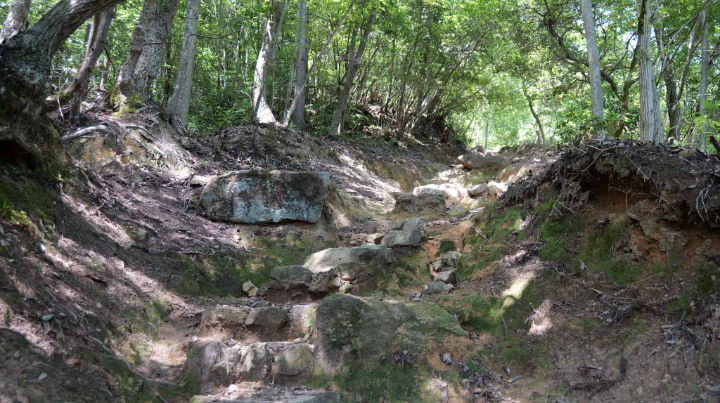
The Takeda Castle Ruins stand on the summit of Mt. Kojō in Asago, Hyogo Prefecture. The time it takes to reach the ruins depends on the route, but the shortest route will take about 15 to 20 minutes. Although the hike is nowhere near as challenging as climbing Mt. Fuji, it still requires some effort. Many large rocks lie along the trail up Mt. Kojō, and some sections can be fairly steep. Because of this, the hike may not be for everyone. At MORIKOBOSHI, we don’t recommend it for those who have difficulty with light physical activity. Those who do make it to the summit will reach an elevation of 354 meters above sea level. Covering 18,473 square meters, the Takeda Castle Ruins are absolutely beautiful.
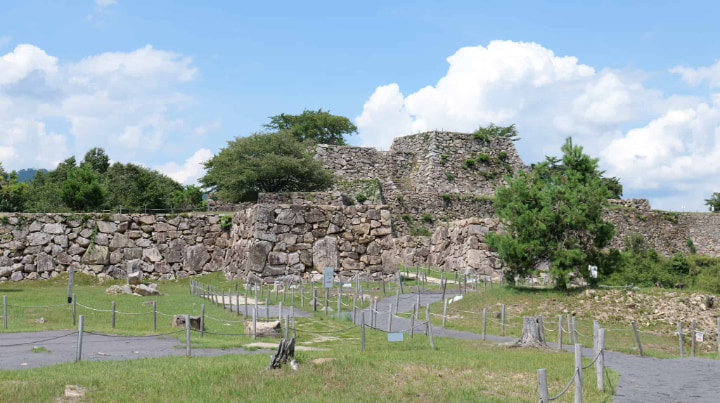
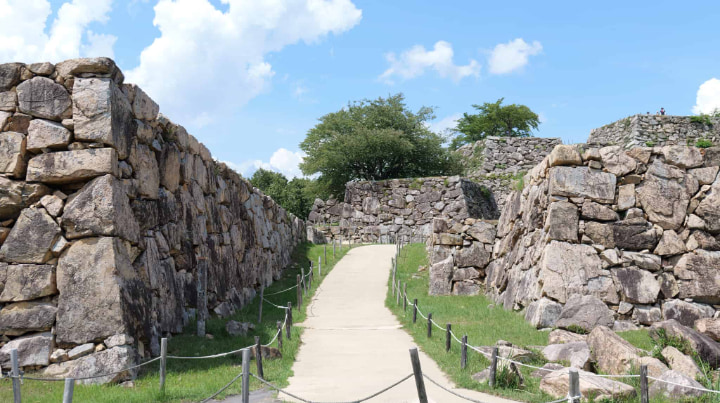
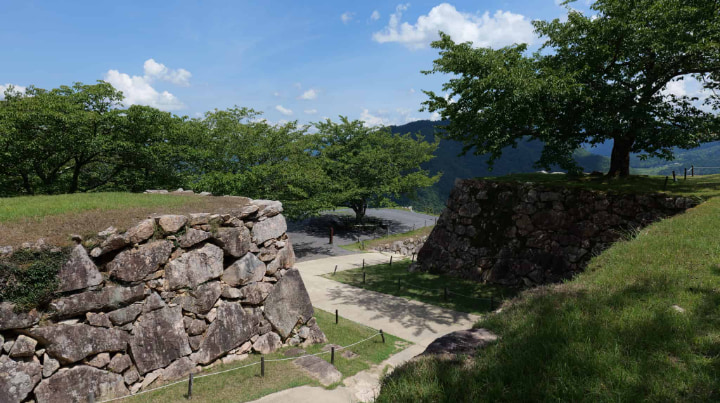
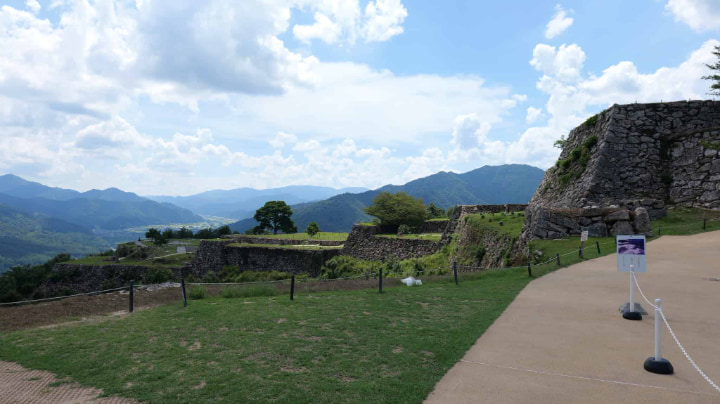
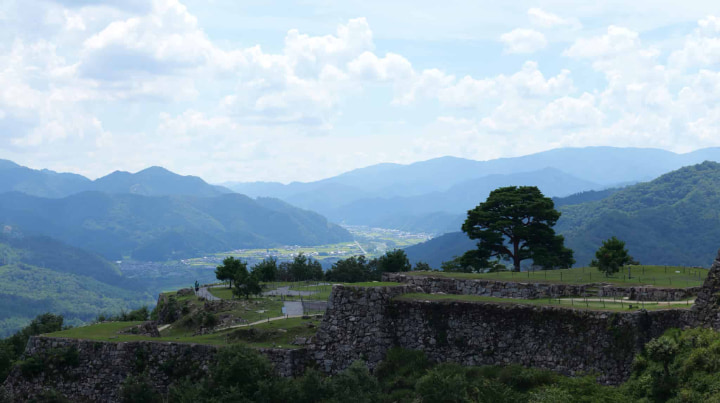
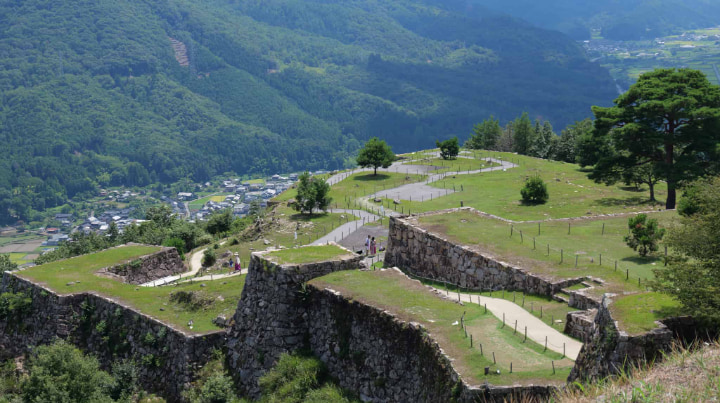
The stone walls of Takeda Castle remain on the summit of Mt. Kojō, making it easy to imagine the castle that once stood here. With the grass (that covers a majority of the summit) and trees here and there, this is some beautiful scenery. One will want to take pictures of it all. From the summit, one can also enjoy spectacular, unobstructed views of the city of Asago below. A walking path circles/goes through the entire Takeda Castle Ruins, making it easy to explore without getting lost. Most visitors can walk around the entire site in approximately 30 to 60 minutes.
The Takeda Castle Ruins are often referred to as both the "Castle in the Sky" and the "Machu Picchu of Japan”. The nickname "Castle in the Sky" comes from the sea of clouds that forms around the ruins. This breathtaking sight can be seen from dawn until around 8:00 a.m. between September and November each year. As the clouds surround Mt. Kojō, they create a dreamlike atmosphere, making it look as if the Takeda Castle Ruins are floating in the sky. Many people visit during this time of year to take photographs. While some take photos from the summit of Mt. Kojō, Ritsuunkyo Gorge, located a short distance away, is one of the most popular viewpoints for photographing the ruins above the sea of clouds.
The nickname “Machu Picchu of Japan” comes from the fact that when the clouds rise around the Takeda Castle Ruins, it looks a lot like the actual Machu Picchu (in Peru).
As mentioned, the Takeda Castle Ruins aren't easy to reach. Visitors must hike along a trail that can be quite steep in places. However, the scenery from the summit is so beautiful that it’s difficult to put into words. The ruins have been featured in numerous television commercials and films. It’s easy to see why once one sees them. One will be treated to even more breathtaking views when the clouds form around Mt. Kojō. For photography enthusiasts, this is a must-visit destination in Japan. If one is visiting Hyogo Prefecture, why not take the opportunity to hike up Mt. Kojō? With its rich history and spectacular scenery, the Takeda Castle Ruins are well worth visiting at least once.
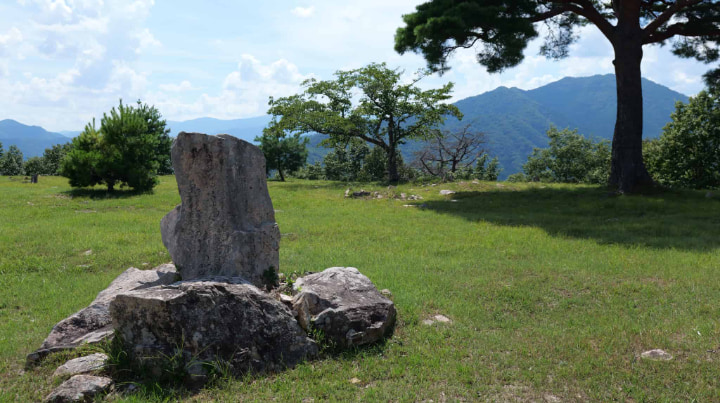
This stone monument features a 俳句 (haiku—a type of Japanese poem) by the famous poet Matsuo Bashō. It's inscribed with the poem 夏草や兵どもが夢の跡 (natsukusa-ya / tsuwamono-domo-ga / yume-no-ato), translated as “Summer grasses—all that remains of warriors’ dreams”. The poem appears in おくのほそ道 (oku-no-hosomichi), commonly translated as The Narrow Road to the Deep North.