Nagato Yumoto Hot Springs
Author: Richard Perkins
Photos/Videos Taken: 2023/09/13
Address: Fukagawa-Yumoto, Nagato City,
Yamaguchi Prefecture 759-4103
In Japan, there are what are known as 温泉 (onsen). Onsen (often called “hot springs”) are naturally heated waters that gush from beneath the earth's surface. This hot water is bathed in, and the Japanese love it. Historical records indicate that hot springs have been used (in Japan) for roughly 1,300 years. Nowadays, a large number of 温泉街 (onsen-gai) can be found throughout the country. Onsen-gai are towns with numerous Japanese inns and other bathing facilities where people can soak in natural hot spring water. Depending on the hot spring, the water is said to be good for one's health. Many contain minerals and other naturally occurring substances that are considered good for the body. It has been believed that bathing in a hot spring can have therapeutic effects similar to those of medical treatment. In Japan, bathing in a hot spring to treat an illness is known as 湯治 (tōji). Many Japanese people (in the past) traveled long distances to visit well-known hot springs specifically for this purpose.
When it comes to hot springs in Japan, many are well known. Some include Beppu Hot Springs in Oita Prefecture and Hakone Hot Springs in Kanagawa Prefecture. However, a prefecture with fantastic hot springs (that’s often overlooked) is Yamaguchi Prefecture. In this prefecture are several high-quality hot springs. One of them is Nagato Yumoto Hot Springs in the city of Nagato. This natural hot spring was discovered during the Muromachi period (1336–1573) by the Zen monk Jōan. According to legend, he discovered it after receiving a divine message from the deity enshrined at Sumiyoshi Shrine in the city of Shimonoseki: 住吉大明神 (sumiyoshi-daimyōjin). Discovered in 1427, this natural hot spring has a history spanning roughly 600 years. It's the oldest hot spring in Yamaguchi Prefecture.
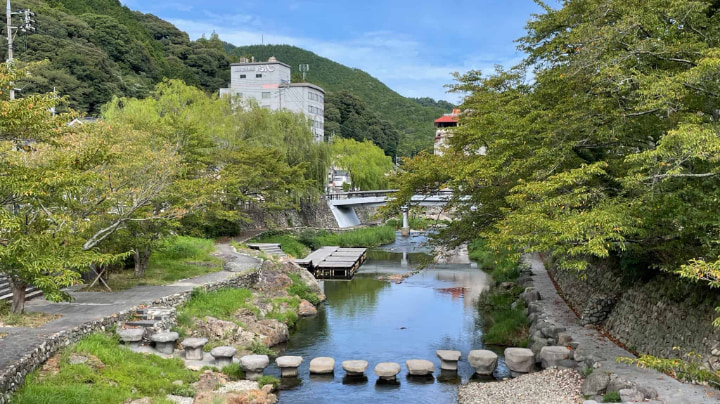
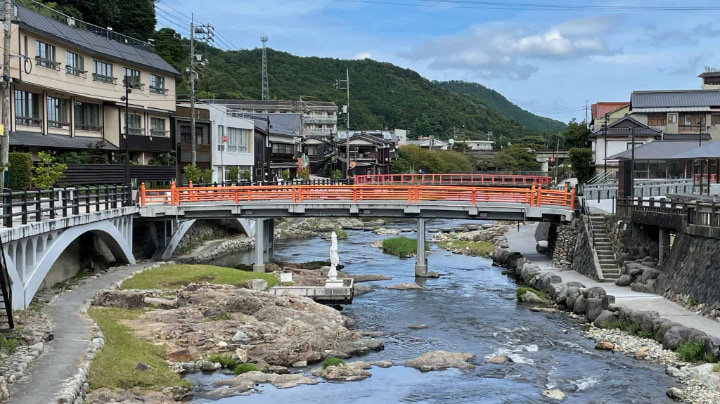
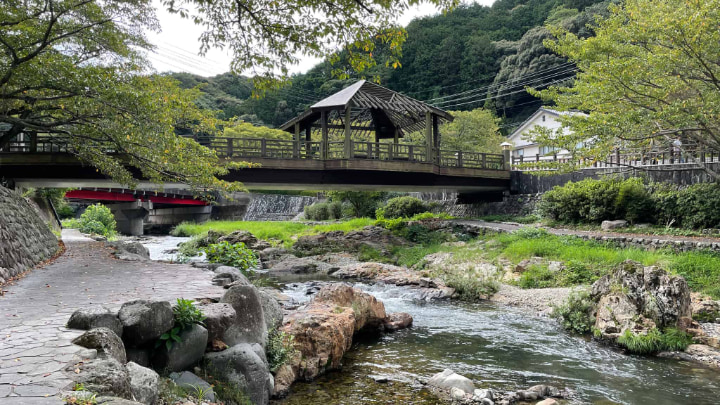
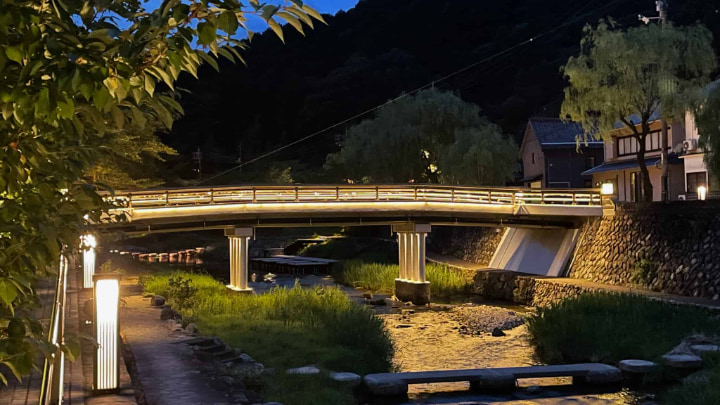
Nagato Yumoto Hot Springs has a calm, tranquil atmosphere. In the middle of this onsen-gai is the Otozure-gawa River. As part of Otozure-gawa River Park, several bridges connect the footpaths on either side of the river. Stepping stones also connect to both sides. One can relax and take a break on the many wooden deck-like areas. With several walking routes too, there are plenty of spots to take in the scenic views. With peaceful surroundings, visitors can unwind and relax.
Around Otozure-gawa River Park, there are several restaurants where one can enjoy regional dishes from Yamaguchi Prefecture, such as 瓦そば (kawara-soba—buckwheat noodles served on a hot plate shaped like a roof tile) and local specialties from Nagato City, such as 焼き鳥 (yakitori—grilled chicken served on skewers).
After a meal, one can enjoy the nighttime illuminations along the Otozure-gawa River. At night, the river looks even more beautiful than it does during the day. Not far away, one will also find the “Bamboo Staircase”, a staircase surrounded by a small bamboo forest. The staircase lights up at night. This creates an enchanting atmosphere and makes for great photographs. With delicious food and beautiful scenery, soaking in the hot springs is not the only pleasure of visiting Nagato Yumoto Onsen.
The best time of year to visit a hot spring is perhaps during the cold winter months. It feels wonderful to warm up one's body on a chilly day. However, Nagato Yumoto Hot Springs is worth visiting not just in winter, but all year. Here, one can enjoy the scenery of each season. In spring, cherry blossoms bloom; in summer, Genji fireflies dance through the air. In autumn, the leaves change color. In winter, if it snows, this onsen-gai becomes magical (and mystic). One can enjoy the scenery outside from many of the baths here. While soaking in the hot spring water, one can appreciate the changing seasons. There's something to look forward to no matter what time of year one visits.
Whether by public transportation or car, Nagato Yumoto Onsen is easy to get to. It's not a particularly large onsen-gai, but it generally doesn't get too crowded. One can enjoy the hot springs here at a more leisurely pace. There are several upscale Japanese inns with a long history, including Ōtanisanso, which was established in 1881. There are also more moderately priced and reasonably affordable inns. No matter the budget, there's an accommodation option to suit almost everyone. It isn’t near major tourist spots (such as Yamaguchi City and Hagi City), but it’s a tranquil, pleasant hot spring to visit. When sightseeing in Yamaguchi Prefecture, why not spend a night at Nagato Yumoto Onsen? Come and enjoy a leisurely soak in its natural hot spring waters.
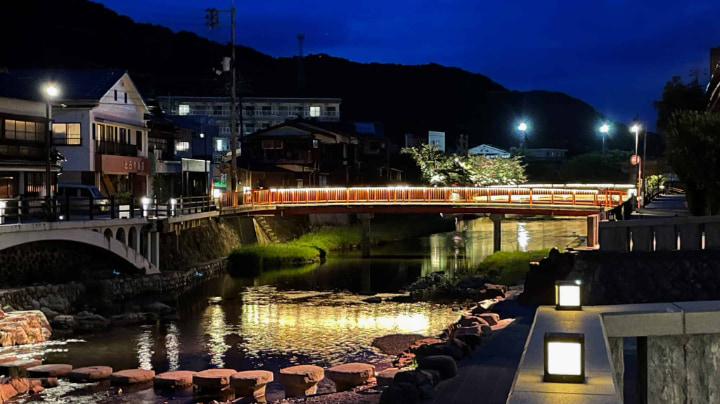
This is the nighttime light-up of the Otozure-gawa River.
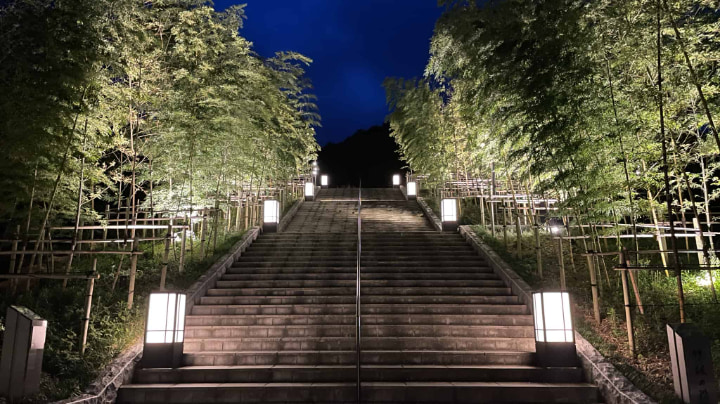
This is the “Bamboo Staircase”.