Tetsujin 28-go Monument|The Giant Robot in Kobe
Tetsujin 28-go Monument — The Giant Robot in Kobe —
Author: Richard Perkins
Photos/Videos Taken: 2025/08/24
Address: Wakamatsu Park, 1-3 Hiyoshicho,
Nagata-ku, Kobe, Hyogo 653-0039
In Japan, there are countless comic books and cartoons. Many of these are popular not only in Japan but also worldwide. One example is Tetsujin 28-go. This was originally a cartoon that became so popular it was later adapted into a televised series. However, the comic books and cartoons aren’t the only way to experience this series. In Kobe, Hyogo Prefecture, visitors can see the iconic robot up close at the Tetsujin 28-go Monument.
Tetsujin 28-go is one of Japan's best-known robot comic books and cartoons. Created by cartoonist Mitsuteru Yokoyama, it was originally serialized in 少年 (shōnen), a comic book magazine targeted at kids, from 1956 to 1966. The story is set during the war. The army tasks Dr. Shikishima and Dr. Kaneda with developing the robot Tetsujin 28-go. Controlled by Dr. Kaneda's son, Kaneda Shōtarō, it moves via remote control. Tetsujin 28-go is used to fight evil organizations. However, Tetsujin 28-go is portrayed as a robot that can be used for both good and evil, depending on who controls it. The television cartoon series first aired in 1963 and ran until 1965.
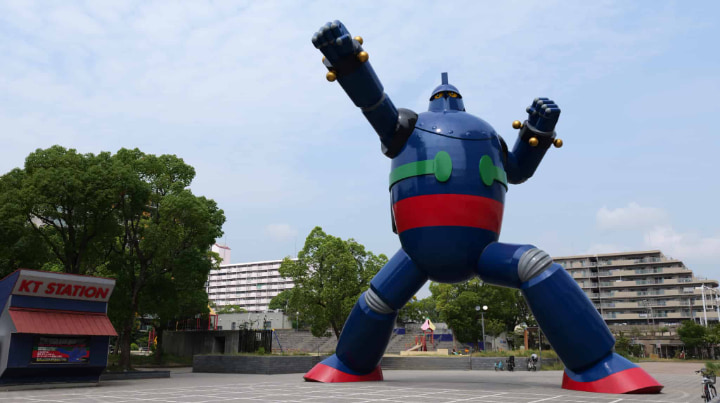
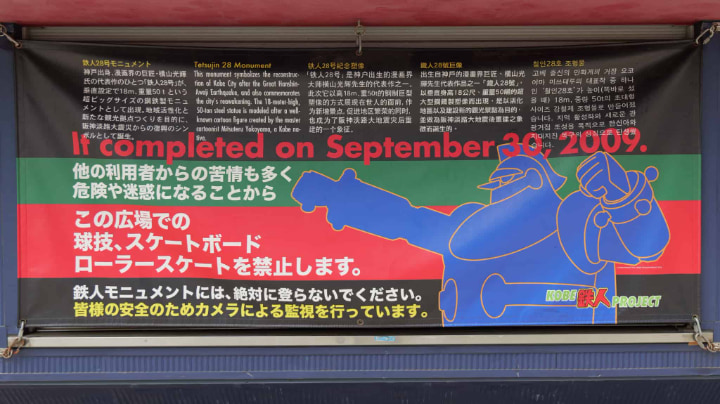
As mentioned, Tetsujin 28-go isn’t a robot that’s only found in comic books and cartoons. At Wakamatsu Park in Kobe, Hyogo Prefecture, lies the Tetsujin 28-go Monument. On January 17, 1995, the Great Hanshin-Awaji Earthquake struck Hyogo Prefecture. The Tetsujin 28-go Monument was built as a symbol of revival and vitality following the earthquake. The monument was also placed here because the series’ creator, Mitsuteru Yokoyama, is from (the city of) Kobe. As a result, Tetsujin 28-go has a deep connection to the city.
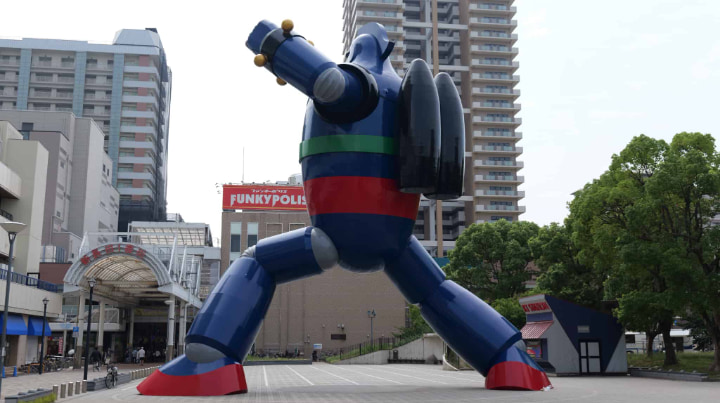
In the comic book and cartoon, Tetsujin 28-go stands 18 meters tall. However, the Tetsujin 28-go Monument is roughly 15 meters and 30 centimeters tall. Despite being smaller than the robot itself, the monument still looks remarkably realistic. It’s an imposing statue that really looks as if it has jumped straight out of the comic book and cartoon. Unfortunately, the monument doesn’t move. Even so, it’s an impressive sight, and many visitors will undoubtedly be overwhelmed by its sheer size. Its vivid blue color gives it a bold and powerful presence. It’s not just fans of Tetsujin 28-go who will be impressed; those seeing this robot for the first time are likely to be blown away too. This is truly a gleaming hero of justice.
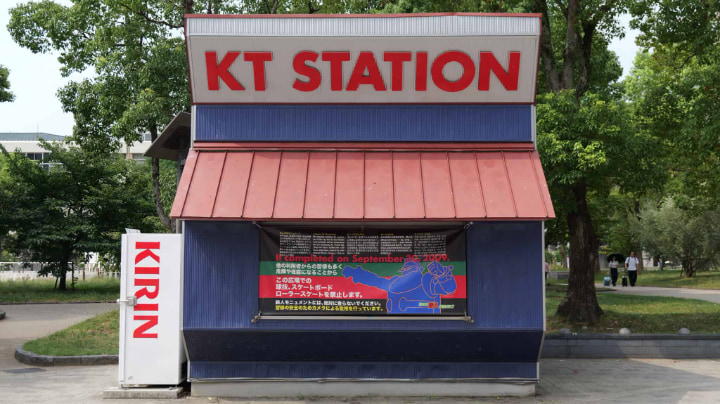
Next to the Tetsujin 28-go Monument, one will find the KT STATION. This small building contains information about Tetsujin 28-go. Even those unfamiliar with this Japanese comic book and cartoon series can learn more about this enormous robot. On top of this, many of the street lamps here feature the head of Tetsujin 28-go. One can really feel how much the locals love this robot. These street lamps also make for great landmarks. After exiting the station, spotting one of these lamps is a sure sign that Tetsujin 28-go is nearby. It’s not just the Tetsujin 28-go Monument itself; Wakamatsu Park is also decorated so that everyone—not just fans—can enjoy Tetsujin 28-go.
Japanese comic books and cartoons are an important part of Japan’s popular culture. They’re also an aspect of the culture that has helped shape Japan into what it is today. Tetsujin 28-go is one of the country’s most renowned comic book and cartoon series, and knowing (at least a little) about it is essential to understanding modern-day Japan. When next in Hyogo Prefecture, be sure to visit Wakamatsu Park and check out the Tetsujin 28-go Monument. This impressive blue robot makes for a fantastic photo opportunity and is something one won’t find in many other parts of the country. It’s also a symbol of Japan’s popular culture. Visiting the monument is, without a doubt, an unforgettable experience and a unique sightseeing opportunity.